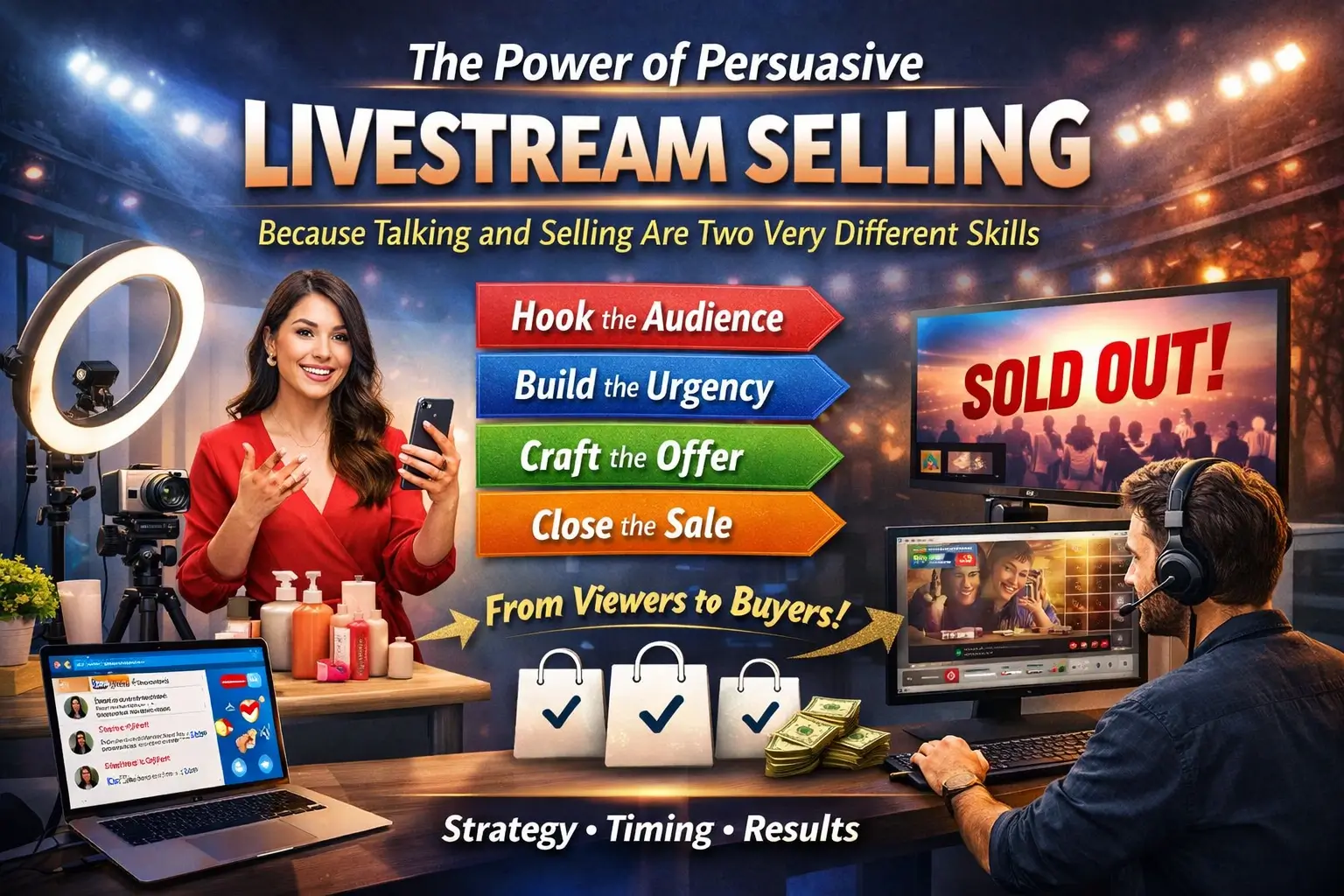
Because Talking and Selling Are Two Very Different Skills
Livestream selling looks deceptively simple from the outside. Turn on the camera, smile, talk about the product, maybe throw in a discount, and—boom—sales start rolling in. At least, that’s how it’s often portrayed on social media.
But anyone who has ever hosted, managed, or invested seriously in livestream commerce knows the truth: talking is easy, selling is not.
At LiveWorks (LW), we’ve learned this the hard way—and that’s exactly why our results look effortless on screen. Behind every smooth pitch and every “Sold Out!” moment lies a carefully engineered system of persuasion, psychology, timing, and relentless testing.
Livestream selling isn’t magic. It’s a craft.
Livestream Selling Is Not About Talking — It’s About Moving People
Anyone can talk. Most people do it every day.
But selling—especially in a live environment—is about guiding decisions in real time.
In a livestream, your audience is distracted, scrolling, comparing prices, chatting, and deciding whether to stay or leave in a matter of seconds. You don’t get the luxury of a polished landing page or a long consideration funnel. You get now.
That’s why livestream selling demands a different skill set:
- Knowing what to say
- Knowing when to say it
- Knowing how to say it
- And knowing when to stop talking and close
At LW, we don’t train hosts to “present products.”
We train them to create momentum.
What Really Happens Behind a “Sold Out” Moment
The audience sees confidence, clarity, and energy.
What they don’t see are the layers underneath.
Before a livestream ever goes live, we’ve already:
- Tested multiple hooks to grab attention in the first 3–5 seconds
- Written and rewritten scripts to balance information and urgency
- Planned emotional beats, offer drops, and closing moments
- Trained hosts to read live comments and pivot instantly
- Prepared contingency flows when engagement dips
There are late nights. There are failed sessions. There are awkward silences and offers that don’t land. Every one of those moments feeds into the next improvement.
We’ve crashed. We’ve learned. And we’ve come back sharper.
That’s how persuasion is built—not by luck, but by iteration.
The Difference Between a Host and a Sales Driver
One of the biggest misconceptions in livestream selling is assuming that a good speaker automatically makes a good seller.
They don’t.
A host can be entertaining, friendly, and articulate—and still fail to convert. A sales driver, on the other hand, understands:
- How to frame benefits instead of features
- How to use scarcity without sounding desperate
- How to repeat an offer without sounding repetitive
- How to turn casual comments into buying triggers
At LiveWorks, our hosts are trained not just to talk—but to listen, adapt, and close.
Every sentence has a purpose.
Every pause has a reason.
Every offer is dropped with intent.
Because in livestream selling, every word counts.
Strategy, Rhythm, and Timing: The Real Engines of Conversion
Great livestreams feel natural—but they are never random.
There is rhythm:
- When to energize the room
- When to slow down and explain
- When to create urgency
- When to ask for the sale
There is timing:
- Knowing when the audience is warmed up
- Knowing when engagement peaks
- Knowing when price resistance is lowest
And there is strategy:
- Structuring the show flow for maximum retention
- Sequencing products to build confidence
- Positioning deals so they feel irresistible, not forced
This is where many brands struggle. They focus on visuals, promotions, or influencers—but overlook the spoken experience.
At LW, persuasion is designed, not improvised.
Why “Just Go Live” Rarely Works
We often hear brands say:
“Let’s just go live and see how it goes.”
And that’s usually exactly how it goes—nowhere.
Livestreaming without persuasion strategy is like opening a store without a salesperson. People may walk in, but they won’t buy.
Going live is not the goal.
Converting live attention into action is the goal.
That’s why our approach is never about showing up—it’s about showing up prepared.
How LiveWorks Turns Conversations Into Conversions
At LiveWorks, we obsess over one question:
What makes someone decide to buy right now?
Our answer lives in the intersection of:
- Human psychology
- Real-time audience behavior
- Clear, confident communication
We train hosts to:
- Speak with clarity, not clutter
- Sell with empathy, not pressure
- Build trust before asking for commitment
- Close confidently when the moment is right
The result? Livestreams that don’t just entertain—but perform.
Ready to See Real Results from Livestream Selling?
If you think livestreaming is just about showing up, let us show you how we show off—with results that speak louder than words.
Whether you’re new to livestream commerce or struggling to convert viewers into buyers, we’re here to help you unlock the real power of persuasive selling.
📩 Contact us for a FREE consultation:
hi@liveworks.my
🌐 www.liveworks.my
And yes—come see how our “magic” brings the bird down from the tree 😉
Frequently Asked Questions (Q&A)
What is persuasive livestream selling?
Persuasive livestream selling is the ability to guide viewers from passive watching to active buying through structured communication, emotional timing, and strategic offers during a live broadcast.
Why is talking not the same as selling in livestreams?
Talking shares information, but selling influences decisions. Livestream selling requires understanding audience psychology, reading live reactions, and knowing when to create urgency or close an offer.
Do I need a script for livestream selling?
Yes—but not a rigid one. A strong livestream uses a flexible script that provides structure while allowing the host to adapt to live comments and audience energy.
What makes a livestream host effective?
An effective host can communicate benefits clearly, build trust quickly, handle objections live, and confidently guide viewers toward making a purchase.
How does LiveWorks improve livestream conversion rates?
LiveWorks focuses on host training, persuasive scripting, timing strategies, and real-time audience engagement to turn conversations into measurable sales results.
Is livestream selling suitable for all brands?
Most brands can benefit from livestream selling, but success depends on strategy, preparation, and execution—not just going live. Proper positioning and persuasive delivery make the difference.